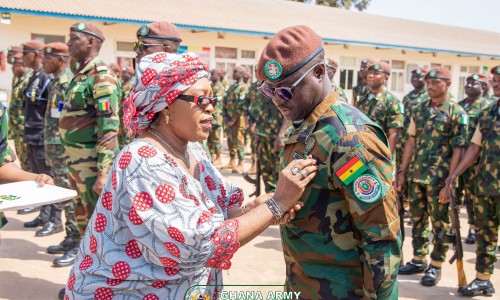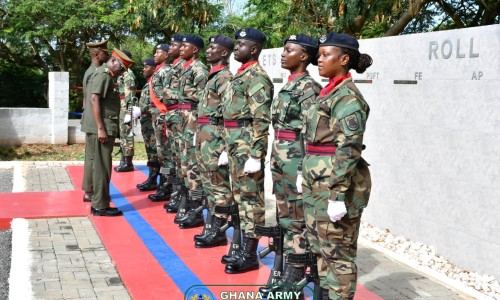

The Commander of the Army Training Command (ATRAC), Brigadier General (Brig Gen) Joshua Amanor, on Monday 2 March 2026, officially opened the United Nations Engagement Platoon training at the Army Peace Operations Training School (APOTS) at Bundase.

Addressing participants at the opening ceremony, Brig Gen Amanor welcomed partners from the Canadian Armed Forces (CAF) and reflected on his early involvement in developing the initial engagement training modules, when standardised United Nations materials were unavailable. He observed that what began as Female Engagement Teams has since evolved into a comprehensive, gender-mainstreamed Engagement Platoon model, now central to modern peace support operations.

Brig Gen Amanor described the Engagement Platoon as a critical force multiplier in complex operational environments. He emphasised that personnel need specialised skills to interact with local communities and to gather reliable situational awareness effectively. According to him, successful peacekeeping goes beyond deployment, emphasising that it requires skilful interpersonal and community engagement, which is vital to delivering on Protection of Civilians mandates.

Brig Gen Amanor expressed profound appreciation to CAF for their continued technical assistance, underscoring the importance of troops taking full ownership of the training package to ensure its sustainability. He then urged participants to approach the course with seriousness and commitment. He noted that the competencies to be acquired would significantly enhance operational effectiveness across all Units.

CAF Contingent Task Force Commander, Lieutenant Colonel Marc Gallant, highlighted what he described as a generations-long friendship between Canada and Ghana. He stated that the CAF considers itself both fortunate and proud to deliver training in support of Ghana’s upcoming UN deployments.

Lt Col Gallant emphasised the specialised role of the Engagement Platoon as a vital enabler within the UN Infantry Battalion, strategically positioned to drive the implementation of key UN mandates, including the protection of civilians, the prevention and response to conflict-related sexual violence, and the advancement of the women, peace and security agenda.
He described members of the Engagement Platoon as agents of change who engage with vulnerable populations and provide commanders with ground-level intelligence essential for operational planning.

Expressing personal enthusiasm for the knowledge exchange ahead, Lt Col Gallant acknowledged both first-time deployers and seasoned veterans, thanking them sincerely for their continued contributions to global peace. He also conveyed profound gratitude for the invitation to collaborate with the Ghana Armed Forces. He extended heartfelt appreciation to APOTS for the warm reception and professional support received since their arrival.

Present at the ceremony were the Commander of the Army Peace Operations Training School, Col Reuben Dela Klutse; the Commanding Officer of UNISFA GHANBATT 5, Lt Col Prince Nadom, the Officer Commanding of ESSMGB, Lt Col Benjamin Danful, the Task Force Commander of CAF, Lt Col Marc Gallant, the Deputy Task Force Commander of CAF, Captain Domingue Arseneau-Bruneau and the Task Force Sergeant Major of CAF, Master Warrant Officer Jonathan Mailman.
Exercise Storm Shield 2026 Commences
13, May 2026
UNMISS Ghanbatt 13 Earns Prestigious UN Medal
08, May 2026
Norwegian Ambassador Visits APOTS
06, May 2026
The Ghana Army, is Ghana’s Land Warfare Component tracing its origins from the Gold Coast Constabulary Regiment (GCCR) in the then British Empire, evolving through the years to become the present-day Professional Ghana Army.
Copyright 2026 Ghana Army - All Rights Reserved